Showing posts with label Treaties. Show all posts

Saturday, 23 May 2015

New world for appellations of origin: Lisbon renaissance in Geneva

The Diplomatic Conference convened to adopt a new Act of the Lisbon Agreement met at the headquarters of the World Intellectual Property Organization (WIPO) on 11 to 21 May 2015 and reached agreement to adopt the Geneva Act.
In preparation for the Diplomatic Conference, the ad hoc Working Group met 10 times from 2009 to 2014 to discuss and draw up the draft text that has yielded this new Act and the Regulations under the new Act.

One of the primary objectives of the new Act is to make the existing Lisbon Agreement on Appellations of Origin and their International Registration, which currently has only 28 Contracting Parties, more attractive for accession by new members.

Some of the main changes will permit accession to the Act by intergovernmental organizations and the international registration of both appellations of origin and geographical indications (up to now the Agreement provided only for the registration of appellations of origin) under a system that is of course in conformity with the TRIPS Agreement while also grounded in many respects in regulations concerning these modalities adopted by the European Union. The Geneva Act also includes Articles dealing with the (broad) scope of protection for geographical indications and appellations of origin in the Contracting Parties and with the subject of official fees (rather unusual in European Union regulations in this area).

Two intergovernmental organizations evinced particular interest over the course of the drafting process for the new Act, namely, the European Union (with the OHIM also present as a separate observer in its own right) and, to a lesser extent, the African Intellectual Property Organization (OAPI). As the efforts of the Working Group earned credibility with the drafting of proposed full wordings for the texts, it sparked the interest of more and more countries, and the delegations of certain world powers (the U.S., Russia, China), which initially either did not take part or were essentially passive participants, became more active, greatly enriching the deliberations, raising very interesting issues and proposals from a variety of legal, economic, and cultural perspectives.

Like the current Lisbon Agreement, registration is not limited to certain goods. Rather, appellations of origin and geographical indications can be registered for all types of goods (agricultural and non-agricultural), provided they comply with requirements.

The Geneva Act will enter into force three months after five Contracting Parties have deposited their instruments of ratification or accession.

It would be remiss to fail to mention the important role played by the delegations of organizations accorded observer status in the Working Group and at the Diplomatic Conference, chief among them CEIPI, for its rigorous academic contributions, MARQUES, oriGIn, and INTA, representing the interests of their members and the general interest of the community at large in achieving a text with the clearest possible wording so as to avert instances of legal uncertainty.


Visit our website: http://www.elzaburu.es/

Monday, 10 June 2013

The Berne Convention in the modern age, with Spanish legal principles as a point of reference


In the tumultuous times currently faced by copyright, the best thing to do is to go back and look for handholds at the source from which considerable rivers, tributaries and springs flowed for authors.  At a time when scientific knowledge seems to be limited to the microscopic boundaries of a 140-character “tweet” or confined to a post in a topical blog, it will be good to take our hats off to genuine scientific contributions.                  

A group of Spanish professors and experts in the field of copyright, led by the master Rodrigo Bercovitz, has just published a commentary of almost 1700 pages on the Berne Convention entitled Comentarios al Convenio de Berna which analyses, provision by provision, the intricacies of this key document in the history of copyright protection.        

The extreme importance of this Convention was consolidated by the tribute paid to it by the World Trade Organization’s TRIPS Agreement, among the tributes paid by many other international and Community initiatives. The WTO decided to adopt Berne as a legal reference framework for all countries.         

International legal doctrine did not, however, rise to the occasion.  Notwithstanding a number of isolated contributions, there did not seem to be any specific work that did justice to the magnitude of Berne’s contribution.  This void has now been filled as a result of this book with Spanish roots.                                                                                                          

Comentarios, published by Tecnos, contains the work of up to 15 university scholars, such as  Pilar Cámara, Ignacio Garrote, José Carlos Erdozaín, Nazareth Pérez de Castro and Rafael Sánchez Aristi, all of whom have proven experience in the field of copyright. It is cause for satisfaction that one of the contributing authors is the Doctor of Laws Patricia Mariscal Garrido Falla, a lawyer at ELZABURU, who provided commentaries on two of the articles of the Convention.                                       

In times of tribulations and uncertainty, it cannot hurt to utter a “long live the Berne Convention"  and delve into this transcendental study in order to find out where we came from and also to figure out where we want to go under expert guidance.


Author: Antonio Castán

Visit our website: http://www.elzaburu.es/

Wednesday, 20 February 2013

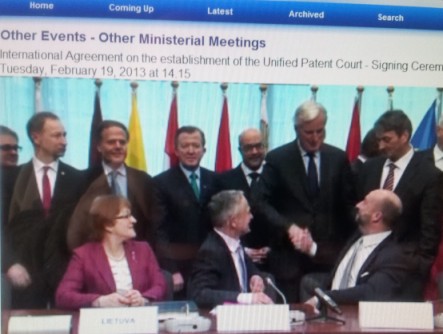
Twenty-four States sign Agreement on a Unified Patent Court in Brussels


The signing ceremony for the International Agreement on a Unified Patent Court took place at 3:15 p.m. on 19 February 2013. The scene in the Council Room at the Justus Lipsius Building in Brussels was a strange one: all the Member States of the European Union present except Spain. Twenty-four of them – all but Bulgaria and Poland, present but not signatories – had just concluded an international agreement to establish a Unified Patent Court outside the institutional framework of the EU. There were just three authentic texts, in German, French, and English, all together in a single volume. Starting with Belgium, one by one they affixed their signatures in the presence of the cameras under the Irish Presidency, with Commissioner Barnier as Master of Ceremonies. Spain's absence had been announced, as had Italy's presence, Italy having decided to sign the Agreement even though it had not joined the enhanced cooperation procedure that had ushered in unitary protection for EU patents for the other 25 EU Member States. Thus, in Italy, the Agreement will apply only to traditional European patents validated in that country.


The Agreement will enter into force on the first day of the fourth month after deposit of the 13th instrument of ratification or accession by the States, provided that these 13 States include France, Germany, and the United Kingdom, unless that date falls in 2013, in which case the Agreement will enter into force on 1 January 2014. Heavy pressure will doubtless be brought to bear on all signatory States to deposit their instruments of ratification by 1 November 2013, which would result in the Agreement's entering into force on 1 April 2014.

The Friends of the Presidency Group (Patents) is to meet in Brussels on Friday, 27 February, with a packed agenda including a review of each State's plans for ratification and an initial exchange of views on setting up the Administrative, Budget, and Advisory Committees.

The ceremony concluded with a family photo – Commissioner Barnier's priceless comment in front of the cameras, "Do you allow the Commissioner to be in the picture?" – and a speech by the President of the Council underlining "this important step towards a new architecture within the European Union". No mention of Spain's absence was made.


Author: Manuel Desantes

Visit our website: http://www.elzaburu.es/

Wednesday, 26 December 2012

WIPO to hold a Diplomatic Conference to conclude a Treaty on Copyright Limitations for the Benefit of Visually Impaired Persons


On 18 December 2012 an extraordinary session of the World Intellectual Property Organization convened a Diplomatic Conference for June of next year. Its main mandate is to conclude a treaty regulating limitations and exceptions for use of copyright to facilitate access to copyrighted works for millions of visually impaired persons and people with print disabilities.


In few countries does current legislation make provision for specific limitations for the visually impaired. In most cases the exceptions made to copyright are intended for the benefit of the handicapped in general, without specifying the type of impairment (as in, for instance, article 31bis, section 2, of the consolidated text of Spain's Copyright Act). Internationally the legal vacuum is still greater, in the absence of any treaty dealing with limitations of this kind. This project is estimated potentially to benefit some 300 million blind or visually impaired persons around the globe, particularly those living in the less developed nations. The future treaty is intended to honour the rights of this group of people to non-discrimination, equal opportunities, accessibility, and full participation and inclusion in society proclaimed in the Universal Declaration of Human Rights and the United Nations Convention on the Rights of Persons with Disabilities.

Under the draft text of the treaty the contracting parties are obliged to make works available to the visually handicapped in an accessible format. This will entail a limitation of the copyright holders’ rights of reproduction, distribution, interpretation, translation and communication to the public (see article C of the draft). The conversion of the works into accessible formats (Braille, large print, audio and other formats) will be undertaken by authorized entities who will similarly have the task of making the copies available to the beneficiaries and facilitating the exchange of works with entities in other countries. The manner in which that exchange is to take place, together with the laying down of parameters to determine what should be understood by the distribution of the works at a reasonable price in the different countries, are issues that will have to be discussed at the conference in the coming month of June.


Visit our website: http://www.elzaburu.es/