Tuesday, 11 March 2014

Shapes of goods to obtain a technical result: Registrable as trademarks?


The CJEU has recently (on 6 March 2014) issued a judgment in joined Cases C-337/12P to C-340/12P on interpretation of Article 7.1.e. CTMR and the requirements to be assessed in the case of trademarks that may comprise the shape of goods necessary to obtain a technical result.

Yoshida is a Japanese company that secured registration for two Community trademarks for certain types of cutlery in Class 8 and kitchen utensils in Class 21.


CTM 001371244


CTM 001372580


In practice the trademarks covered knife handles with concave dents for knives sold by Yoshida, as shown below.

Image downloaded from www.yoshikin.co.jp
  
The patterns of concave dents, also protected by several patents, served the purpose of helping to prevent the knives from slipping out of the user's hand when slicing.

Three companies, Pi-Design, Bodum France SAS, and Bodum Logistics A/S, filed applications with the OHIM for declarations of invalidity of the Community trademark registrations on grounds that they lacked distinctive character and were in breach of Article 7.1.e. CTMR, that is, that the trademarks consisted of the shape of goods necessary to obtain a technical result. After various appeals the matter reached the CJEU, and in its decision the Court first points out that the absolute grounds for refusal laid down in Article 7.1 CTMR are to be interpreted in the light of the public interest and that no company was entitled to a monopoly on technical solutions or product's functional characteristics.

The Court then points out that for proper application of Article 7.1.e CTMR the essential characteristics of the trademark need to be properly identified. Identification of the said essential characteristics requires a case-by-case assessment, taking into account the overall impression produced by the sign on consumers along with the various types of elements making up the sign, while having in mind that there is no hierarchy systematically applicable to the said elements. Furthermore, Article 7.1.e CTMR applies to both two-dimensional and three-dimensional trademarks.

The Court has also ruled that besides the above, it is also appropriate to take into account such other additional aspects as the filing date of the trademark application, to establish whether the grounds for invalidity had effect on that date, and additionally how the trademark has been used in practice since the filing date and whether there are earlier patents in existence. In not doing so the General Court erred in law.


Since the preceding aspects had not been taken into account, the CJEU referred the matter back to the General Court for judgment.


Visit our website: http://www.elzaburu.es/

Friday, 7 March 2014

Success with consumers may do in the KORNSPITZ brand for bread rolls


In its judgment of 6 March 2014 in Case C-409/12, the Court of Justice of the European Union ruled on the conditions to be fulfilled for a declaration of revocation of a trademark due to loss of distinctive character.
In the case in question, the Austrian trademark KORNSPITZ had become the commonly used name for a type of bread roll among consumers but not among bakers, who baked the rolls and sold them to the public from a mix supplied by the trademark owner.


The Court followed the ruling already made in its judgment of 29 April 2004 in Case C-371/02 (Björnekulla Fruktindustrier) in a similar matter, though involving pickled gherkins instead of bread rolls. In the opinion of the Court, the consumers' or end users' perception of the goods is a decisive factor in assessing whether a trademark has become commonplace. It therefore concluded that a trademark may be cancelled on grounds of lost distinctiveness where it has become the common name for a product among consumers but not among sellers of that product.
The Court then considered the conditions in which a trademark owner's conduct may be deemed to be "inactivity" within the meaning of Article 12.2.b) of Trademark Directive 2008/95, more specifically, whether the trademark owner's failure to take action to encourage sellers of the product to inform customers that the name is a registered trademark can be regarded as "inactivity".
The Court answered that question in the affirmative, which quite clearly places a heavy burden on trademark owners.
Lastly, the Austrian court that referred the issue for a preliminary ruling also asked whether revocation of a trademark on grounds that it has become the common name for a product necessarily presupposes that it must be ascertained whether there are other names for that same product besides the registered trademark.
The Court ruled the existence of other names to be irrelevant in that in no case would that alter the fact that the trademark had become the commonly used name for the product, the condition for revocation laid down in the Directive.

Author: Carlos Morán


Visit our website: http://www.elzaburu.es/


Monday, 3 March 2014

End of the road for counterfeiting goods in transit in the EU

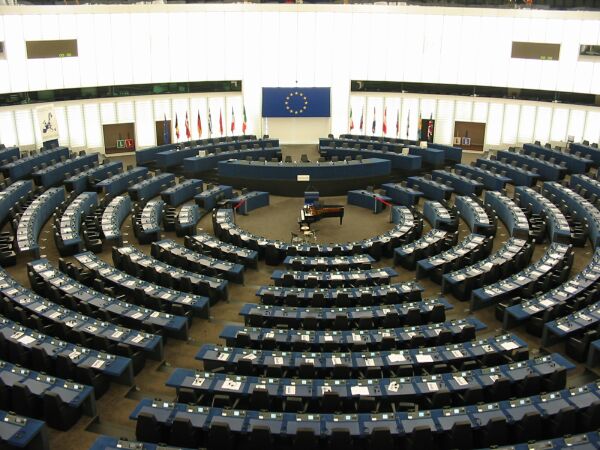
European Parliament
By Cédric Puisney
(via Wikipedia)

On 25 February 2014 the European Parliament gave its approval to the Proposal for a Directive of the Parliament and of the Council to approximate the laws of the Member States relating to trade marks (recast).

The interesting new provisions contained in the proposal include certain measures which numerous organizations and enterprises across a broad range of sectors have long been calling for, in that they are intended to put an end to the freedom of transit of counterfeit goods through the customs territory of the EU even when those goods are destined for a country outside the Union. The measures approved in this regard are, specifically, the following:

1. The holder of the trademark right may prevent goods coming from third countries and bearing a counterfeit trademark from entering EU territory.

2. The holder of the right may take appropriate legal steps and actions against counterfeit goods. These include the right to request national customs authorities to implement measures to detain and destroy such goods under the new customs Regulation (EU) No. 608/2013.

3. The holder of the right may also prevent the entry into the EU of small consignments of counterfeit goods, particularly in the context of sales over the Internet. 

A small consignment is defined in Regulation (EU) No. 608/2013 as a postal or express courier consignment containing three units at most or having a gross weight of less than 2 kg.

Parliament proposes that in these cases the individuals or entities who ordered the goods should be notified of the reason why the measures have been taken and similarly be informed of their legal rights vis-à-vis the consignor.

The provisions thus approved in connection with small consignments follow on from the recent judgment of the Court of Justice in case C-98/13, published on 6 February 2014, in which it was held that, even where the sale of goods for own use had taken place through a website in a non-member country, the holder of the intellectual property right could not be deprived of the protection afforded by the customs regulation and the consequent power to prevent those goods from entering the European market, without there being any need first to ascertain whether the goods had previously been the subject of an offer for sale or advertising targeting European consumers.

In conclusion, the European Parliament has taken a great step forward in the fight against counterfeiting on all fronts and not just inside its territory.

Autor: Transi Ruiz

Visite nuestra página web: http://www.elzaburu.es/

Is proof of damages required in Spain if patentee opts for equivalent royalty?


Article 13 of the Enforcement Directive 2004/48/CE rather confusingly seems to equate equivalent royalty with damages, whereas in many continental legal systems it might fit more easily into the category of unjust enrichment i.e. the infringer has obtained something to which he has no legitimate right. 


The reference to damages, which has been transposed in Article 66 of the Patents Act has caused particular problems in Spain where case law has traditionally held that damages must be “real and effective” and strictly limited to those that are proven. Should the patentee then have to prove damages if he opts for equivalent royalty which, after all, has nothing to do with any actual damage he has suffered? This has led to some rather confusing and contradictory case law and the development of the doctrine of “ex re ipsa” which seeks to somehow fit equivalent royalty into the traditional picture by saying that there is no need to prove the existence of damage if by the nature of the thing under analysis (res), the existence of damage is clear (from the thing itself). However it would have been much better to acknowledge that as equivalent royalty cannot really be equated with the continental law concept of damages, as then the question of proving damages does not even arise.

This is exactly what the Madrid Appeal Court has done in Judgment no. 25/2014 of 24 January 2014 in appeal no. 578/2012. The ruling sets out that the purpose of equivalent royalty is not to compensate a loss suffered by the patentee, but rather the illegitimate invasion of his exclusive right. The Court does not say that it is necessary to show that the existence of a loss is self-evident (ex re ipsa) but rather that there is no need to prove or even consider any such loss. This comes as good news to patentees who up to now ran the risk that a court might find that the loss was not as self evident as they claimed e.g. when the patentee himself is not exploiting the patent in Spain and has made no preparations to do so either directly or through the granting of licenses. Even better, the Court gives clear guidance on what type of equivalent license terms can be sought including an up front payment, a fixed minimum monthly royalty and variable royalty based on sales. This is good news for patent litigators in Spain where judges traditionally tend to be guarded in their damages awards.


Author:Colm Ahern

Visit our website: http://www.elzaburu.es/

Wednesday, 26 February 2014

INTERPOL and EUROPOL: efficacy against counterfeiting

INTERPOL Headquarters
By Massimiliano Mariani (via Wikipedia)

Through Operation Opson III INTERPOL and EUROPOL have once again become the scourge of the organized crime networks behind counterfeiting at the transnational level.

Within the framework of the operation, reported by EUROPOL on 13 February 2014, thousands of tonnes of foodstuffs and hundreds of thousands of litres of drinks, all counterfeit or unregulated and potentially harmful, were seized. The actions extended to 33 countries throughout Europe, America and Asia and were carried out with the aid of national police forces, private sector organizations and customs authorities. The operation was the third in a series launched by INTERPOL and EUROPOL in 2011 under the codename “Opson”  (meaning “food” in ancient Greek) which is aimed at combating illicit trade in counterfeit foodstuffs at the transnational level and has so far resulted in the arrest of over three hundred people and the seizure of vast amounts of goods to the value of hundreds of millions of dollars. This series of blows to the organized crime networks bears witness to the extraordinary organizational and operational capacity of INTERPOL and EUROPOL and to the commendable coordination of the police forces of the different countries.

The work performed by INTERPOL in the intellectual property field is particularly noteworthy. In 2012 it set up a programme against trafficking in illicit goods and counterfeiting with a view to improving transnational cooperation in this area between the security forces of the member States. INTERPOL rates offences against intellectual property to be highly damaging to the whole of global society and highlights the increasingly preponderant role of international mafias, to which this Blog in turn referred in a previous post.

Although the figures on the growth in worldwide traffic in counterfeit goods are dismaying, the increased effectiveness of operations undertaken against it by these Community and international police forces are to be highlighted. In 2012 INTERPOL launched Operation Maya in various Central and South American countries, where over 1,000 police interventions took place and 200 arrests were made, and Operation Black Poseidon in Eastern Europe entailing over 1,700 interventions and the seizure of goods to the value of 122 million euros. EUROPOL, for its part, conducted Operation Leatherface, which resulted in the dismantling in various provinces of Spain of a  transnational network connected with the Camorra and engaging in illicit trade in counterfeit goods. In Operation Pangea INTERPOL and EUROPOL worked together, with the assistance of other public and private sector bodies, to dismantle a network involved in the online sale of counterfeit pharmaceuticals. In the course of that operation 58 people were arrested and 9.8 million items of goods, which would have had a market value of 41 million dollars, were seized.

The third phase of Operation Opson, which exemplifies the spirit of cooperation and capacity for coordination of INTERPOL and EUROPOL, is still ongoing. Thanks to this work consumers and trademark owners are safer, while international criminals are more uneasy.

By Eyehook
(via Wikimedia)
In Spain ELZABURU is involved, within the framework of Operation Opson III, in the pursuit of a criminal organization engaging in the production and distribution of counterfeit French champagne originating in Italy. EUROPOL is working on the investigation.

Wednesday, 12 February 2014

Can an EU resident purchase a counterfeit product from a Chinese online sales website, even if it is for private use?

By Frank Williams
Vía Wikipedia

The user will certainly be able to buy it. But may never end up receiving it: on entry of the counterfeit product into the EU territory the Regulation relating to the seizure by customs authorities of goods suspected of infringing intellectual property rights will be applied and, as a result, the counterfeit product will be seized and, as the case may be, destroyed.

This is the judgment handed down by the Court of Justice (Second Chamber) in case C-98/13, which was just published on 6 February 2014.

The facts of the case date back to January 2010 when a Danish citizen (Mr. Blomqvist) bought a Rolex watch from a Chinese online sales website and paid for it through the same website. The parcel was sent from Hong Kong to the address of Mr. Blomquvist in Denmark, but was seized by the Danish customs authorities pursuant to EC Regulation no. 1383/2003, which was in force at the time, on grounds of infringement of the industrial and intellectual property rights of the rightholder, Rolex. The Danish importer opposed the destruction of the watch on the grounds that he had bought it lawfully for his own personal use.

The Court of Justice ruled that, although the sale of the goods occurred through a website located in a country outside of the EU, the holder of the industrial and intellectual property rights cannot be denied the protection afforded to that holder by the customs regulation and that, as a result, the counterfeit goods must be prevented from entering the EU territory. It is not necessary to check whether the goods have previously been the subject of an offer for sale or advertising targeting European consumers, because the sale has been accredited.

Consequently, this judgment represents a serious warning to those purchasing goods online: counterfeit goods purchased from websites outside of the EU can be seized and destroyed when they enter EU territory, irrespective of the use made of them.


Visit our website: http://www.elzaburu.es/

Wednesday, 29 January 2014

Financing villainy: the relationship between counterfeit goods and organized crime


Under the title “Look behind”, on 14 January the United Nations Office on Drugs and Crime (UNODC) launched a public awareness campaign aimed at highlighting the close global relationship between organized crime and piracy and counterfeiting of goods. The campaign is based on an advertising spot that premiered on the NASDAQ screen in New York's Times Square, subsequently to be broadcast via the most influential media in the more than ten languages into which it has been translated. By investments of this kind, the UN is showing that it is ever more aware of the danger posed by piracy and counterfeiting, as well as the repercussions of these activities on society and its members.

The counterfeiting business moves billions of dollars around the world every year, a fact that is not lost on the international networks of organized crime. Countless criminal organizations have been associated with this type of illicit trafficking, and their relationship with these activities has been duly proven. Italian groups such as the Cosa Nostra or the Neapolitan Camorra, as well as the Russian Mafia, have been linked to counterfeit goods trafficking in operations conducted by INTERPOL in Latin America and by Europol in Europe. In Asia, where the manufacture of very low-quality goods bearing third party distinctive signs is astonishingly simple to carry out in view of the low production costs, groups such as the Japanese Yakuza and the Chinese Triads dominate these production and distribution processes, with capacity to expand operations throughout the world.

Bodies such as INTERPOL have warned that the web of an international criminal organization often lies behind the counterfeit market, and the profits made by this illicit trade serve to finance other crimes such as human trafficking, money laundering and drug trafficking. The low penalties handed out for crimes against industrial property only serve to encourage organized crime groups to participate in what is a multi-million dollar market (the benefits of which might even exceed those of drug trafficking) and for which criminal punishment in the event of conviction is ludicrous compared to the potential profits to be gained. 
By Frank Schwichtenberg
Vía Wikimedia
Trafficking of counterfeit goods is closely linked to the following crimes:


·   Money laundering. Criminals use counterfeiting to launder money obtained from their various illicit activities. By introducing these goods into regular distribution channels, passing them off as originals through supposedly legitimate businesses, they are able to ensure that any profit has been properly laundered by the time it reaches the bosses of these groups.

·   Labour exploitation. As mentioned in the campaign's spot, the mafias engaged in counterfeiting activities take advantage of the situations in developing countries to produce goods of this type there. Working in conditions that are more than precarious for ridiculously low or non-existent wages over the course of interminably long hours is the daily reality for thousands of people (many underage) who are exploited by these criminal groups in factories.

·   Extortion and bribery. With a view to facilitating the flow of illicit items across different countries, these organisations habitually resort to bribery or corruption of however many individuals may be necessary. Extortion and threats to distributors and retailers alike who do not wish to "cooperate" are another feature of crimes against industrial property.

·   Fiscal crimes (tax fraud). According to figures released by the Organization forEconomic Cooperation and Development (OECD), the value of the counterfeit goods traded globally each year amounts to around 250,000 million dollars, a figure that evades government coffers and reaches criminal organisations in its entirety.

Although industrial property crime still enjoys a certain degree of social tolerance and is considered a "minor" crime, there is no doubt that it also represents a serious risk to consumer health. Buying counterfeit goods is not a simple and innocuous way of saving money without repercussions for the rest of society; rather, it actively contributes to the financing of organized crime, it encourages the continued exploitation of workers slaving away in factories, and it serves to fatten the wallets of the "capos". Unlike other activities by international mafias, trafficking in counterfeit goods has the advantage of exponentially multiplying the number of potential consumers, in that the activities are not directed at a handful of poor wretches, African warlords, or terrorist groups. They are directed at people who are perfectly normal and have no connection whatsoever with any type of criminal activity, taking advantage of their blindness to the damage that purchasing these items causes both to themselves and to all the victims behind the trade. This is why the public needs to be made aware of all that lies on the other side of counterfeit goods and, once again, to look behind.


Visit our website: http://www.elzaburu.es/